Typical Combustion and Flavor Defects Caused by Uncontrolled Fermentation Temperature or Humidity — Identification Methods
Preface: The Balancing Point of Life's Rhythm
In the field of tobacco fermentation, we have never regarded it as a mere chemical reaction process, but rather as an exquisitely precise, dynamic biochemical symphony imbued with a "sense of life." A fermentation pile is not a static mass of organic matter, but a micro-ecosystem driven by enzymes, microorganisms, thermal energy, and moisture. As process technicians, we are not merely managers but conductors of this symphony.
The core of this symphony lies in the perfect coupling of two variables: temperature and humidity. They determine how proteins degrade in tobacco leaves, how alkaloids transform, how sugars undergo the Maillard reaction, and most importantly — how aroma precursors precipitate through complex redox reactions. Once the conductor's baton of these two variables deviates, the melody quickly descends into chaos, ultimately manifesting as the collapse of physical combustion properties and catastrophic flavor defects during consumption.
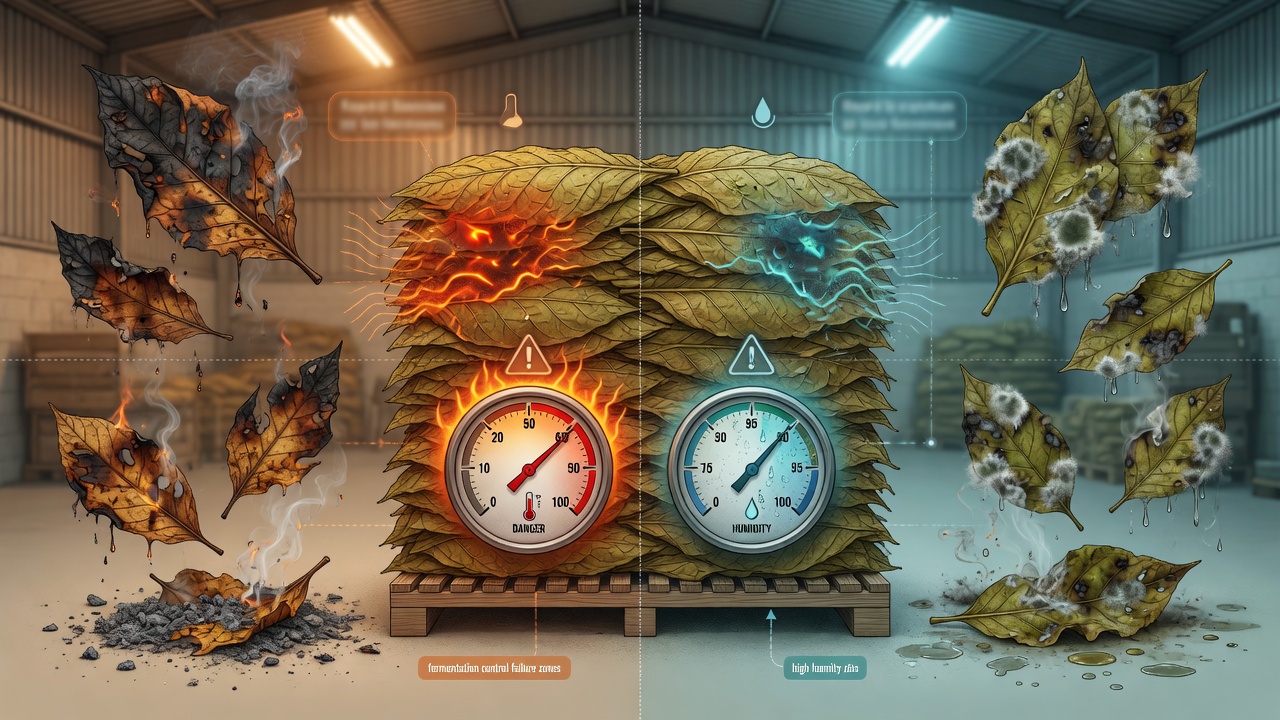
I. Temperature Uncontrolled: The Revelry and Ruin of Chemical Reactions
Temperature is the "engine" that drives the rate of fermentation reactions. It determines the depth and speed of reactions, but this power can very easily swing toward two extremes.
1. Extreme High Temperature: The Uncontrolled "Cooking" Effect
When the core temperature of the pile突破 45°C and approaches 50°C, the fermentation process is no longer a slow transformation but evolves into a destructive "cooking" effect.
Technical Mechanism and Chemical Variation
Under high-temperature conditions, proteins in tobacco leaves undergo irreversible denaturation — not merely a morphological change, but a shift in the amino acid profile produced by degradation. More critically, the key volatile components in tobacco leaves — especially the essential oils that determine tobacco richness and carotenoid degradation products — accelerate volatilization or undergo excessive oxidative degradation at high temperatures.
Impact on Combustibility
From a physicochemical perspective, high-temperaturerunaway/loss of control directly interferes with the balance of potassium (K⁺) and chloride (Cl⁻) ion ratios. Excessive heat accelerates the migration and release of chloride ions, causing a significant decrease in the K⁺/Cl⁻ ratio. During combustion, this ionic imbalance directly manifests as loss of combustion uniformity: tobacco leaves may burn out quickly in some areas while extinguishing or burning slowly in others. Meanwhile, the ash becomes disorderly, with black or uneven gray-white coloration, losing the clean and stable ash形态 characteristic of high-quality tobacco.
Manifestation of Sensory Defects
The manifestation in flavor is extremely直观 and difficult to reverse. Due to the loss of essential oils and protein denaturation, the smoke loses its original "meatiness" and "body," becoming abnormally "hollow." This is replaced by unpleasant burnt notes or rancid flavors. This sourness often originates from organic acids produced by excessive oxidation.
Case Study: The "Midnight Crisis" of Summer 2022
I recall a late night in July 2022, when consecutive high-temperature weather combined with a brief ventilation system failure caused the core temperature of a large pile to soar from 38°C to 52°C in just 4 hours. When we urgently initiated the turning procedure, the scent was no longer the mature, sweet aroma of tobacco leaves, but a pungent mix reminiscent of "burned feathers" mixed with sour rot. Even after prolonged cooling and remediation, the combustion stability of that batch of tobacco leaves could not meet standards, and the dry, bitter sensory特征 during consumption became an indelible mark on our subsequent quality inspections.
2. Low Temperature Stagnation: Incomplete Transformation
If high temperature is "revelry," then a low environment below 30°C is a "silence."
Technical Mechanism
Low temperature leads to a significant decrease in enzyme activity, and microbial metabolic activity enters a dormant state. This means that the most challenging components in tobacco leaves — proteins, starches, and certain alkaloids — cannot be thoroughly degraded.
Sensory and Combustion Defects
Due to incomplete transformation, tobacco leaves carry a strong "green/raw smell" or "grassy odor." This odor is caused by residual chlorophyll and undegraded proteins. In terms of flavor, such leaves exhibit extremely high irritation, with harsh, unrefined smoke, lacking the smoothness and sweetness that should come after fermentation maturity.
In terms of combustion performance, low-temperature fermented tobacco leaves often produce a pungent, "burning hay"-like smoke during combustion, directly reflecting insufficient cellulose degradation and the violent reaction of residual macromolecular substances during high-temperature burning.
II. Humidity Uncontrolled: Collapse and Reconstruction of Sensory Structure
If temperature determines the "depth" of reactions, then humidity determines the "dimension" of reactions — it shapes the physical structure of tobacco leaves and the migration channels of aroma substances.
1. Excessive Humidity: The Undercurrent of Mold
When the relative humidity (RH)is consistently maintained at 85% or above, or whenlocal moisture accumulates inside the pile, disaster begins.
Technical Mechanism
High humidity environment reduces the porosity inside the pile, hindering effective oxygen penetration, thereby creating local micro-anaerobic conditions. This not only suppresses the beneficial aerobic fermentation process but also provides a breeding ground for theuncontrolled growth of mold and anaerobic microorganisms.
Damage to Combustion and Flavor
Excessive moisture directly leads to the softening of the physical structure of tobacco leaves, and even the appearance of "water stains." This structural damage manifests during combustion as uneven burning, wet collapse of ash, or abnormal combustion trajectories.
In terms of flavor, the most direct threat brought by high humidityrunaway/loss of control is "moldy taste" and "putrid odor." Secondary metabolites produced by microbial metabolism completely destroy the original aroma profile of tobacco, making the smoke turbid, chaotic, and accompanied byobvious的 ammonia abnormality.
2. Insufficient Humidity: Dry Stagnation
Conversely, when humidity is controlled below 60%, or when水分 drops too quickly in the later stages of fermentation, the fermentation process falls into a state of "dry stagnation."
Technical Mechanism
Moisture is the medium for enzymatic reactions. Too little moisture causes water migration to stop, chemical transformation tends to stagnate, and the tobacco leaves become brittle and easilybroken.
Due to insufficient moisture, aroma precursors cannot effectively migrate and transform between tobacco leaf tissues, resulting in insufficient aroma in the final product, appearing as "flat," "tasteless," or "aroma-flattened." During combustion, such brittle leaves often lack necessary combustion stability and tend to producebroken smoke dust.
III. Synergistic Effects: The Deadly Dance of Temperature and Humidity
In actual production, temperature and humidityrunaway/loss of control often do not occur in isolation; they frequently present asituation of "synergistic destruction."
High Temp + High Humidity
- Mold → Rot → Scorch
- Local blackening
- Mold + Ammonia + Burnt Bitter
- Complete loss of commercial value
Low Temp + Low Humidity
- Complete fermentation stagnation
- Retains original green-raw flavor
- Extremely high breakage rate
- Extremely harsh smoke
The mosttypical deadly combination is "high temperature + high humidity." This combination is simply a "booster" for mold and excessive degradation. High temperature accelerates chemical reactions, while high humidity provides ample medium for microorganisms. In such an environment, tobacco leaves rapidly experience a destructive process from "mold" to "rot" and then to "scorching." You will find the leaf color not only uneven but even locally blackened, with the flavor being a mixture of moldy, ammoniacal, and burnt bitter tastes, completely losing its commercial value as a tobacco product.
Another combination is "low temperature + low humidity." This causes the fermentation process to completely stagnate, with leaves not only retaining theiroriginal green-raw flavor but also becoming extremely脆 due to very low moisture, resulting in a very high breakage rate and extremely harsh smoke during combustion.
IV. Identification and Correction: The Expert's Sensory and Data Toolbox
Facing the complex production site, we cannot rely solely on intuition; we must构建 a dual identification system of "sensory + data."
1. Sensory Identification: The Frontline Worker's "Instinct"
Sniff Test: This is the most sensitive sensor. Healthy tobacco leaves should have a mature, slightly sweet, or specific aromatic scent; if you smell acidity, be alert for high temperature; if you smell moldy or putrid odor, be alert for high humidity; if you smell green-raw odor, be alert for low temperature.
Touch Test: Judge moisture and structure by feeling the elasticity of the tobacco leaves. Normal leaves should have good toughness and resilience; if too soft and mushy, it indicates excessive humidity or structural damage; if too brittle and crumbles when pinched, it indicates insufficient humidity or over-fermentation.
Visual Inspection: Observe color consistency and oil content. Overly dark or locally blackened color is usually a signal of excessive high temperature; water stains or mold spots are ironclad evidence of high humidity; light and dull coloration indicates low temperature or insufficient fermentation.
2. Technical Data Monitoring: Science's "Timpani"
pH Value Monitoring: Drastic fluctuations in pH value are a direct indicator of changes in the chemical environment.
K⁺/Cl⁻ Ratio: This is a hard indicator for evaluating combustion stability. By regularly sampling and testing this ratio, trends in combustibility can be predicted.
Moisture and Temperature Correlation Curve: Establish real-time monitoring temperature-humidity curves. By analyzing the rate of change and hysteresis of temperature and humidity, predictive turning or cooling can be performed before defects truly manifest.
Conclusion
Tobacco fermentation is an art of "measure." Temperature and humidity are not simple physical parameters; they are the levers that regulate the soul of tobacco. Excellent process experts must not only see trends from data but also hear, from the wisp of drifting smoke, the faint warnings of temperature and humidityrunaway/loss of control emitted by the fermentation pile. Only by revering these parameters and precisely controlling these variables can we present that perfect, mellow art in every burn.